


In the beginning, you want a objective, then you definately want the plan to realize that objective. I can not consider any situation the place one would do some work with out both of these. Though AI and to some extent AI Brokers have been round for a very long time, they’ve solely lately (2 years?) turn into mainstream and closely invested in by companies. I point out that as a result of we’re embarking on this subsequent wave and are within the midst of defining and discovering the very best frameworks, options, and architectures for these AI Agent intelligence to execute our advanced workflows most effectively and successfully.
I’ve written quite a few articles thus far relating to foundational and superior orchestration patterns.
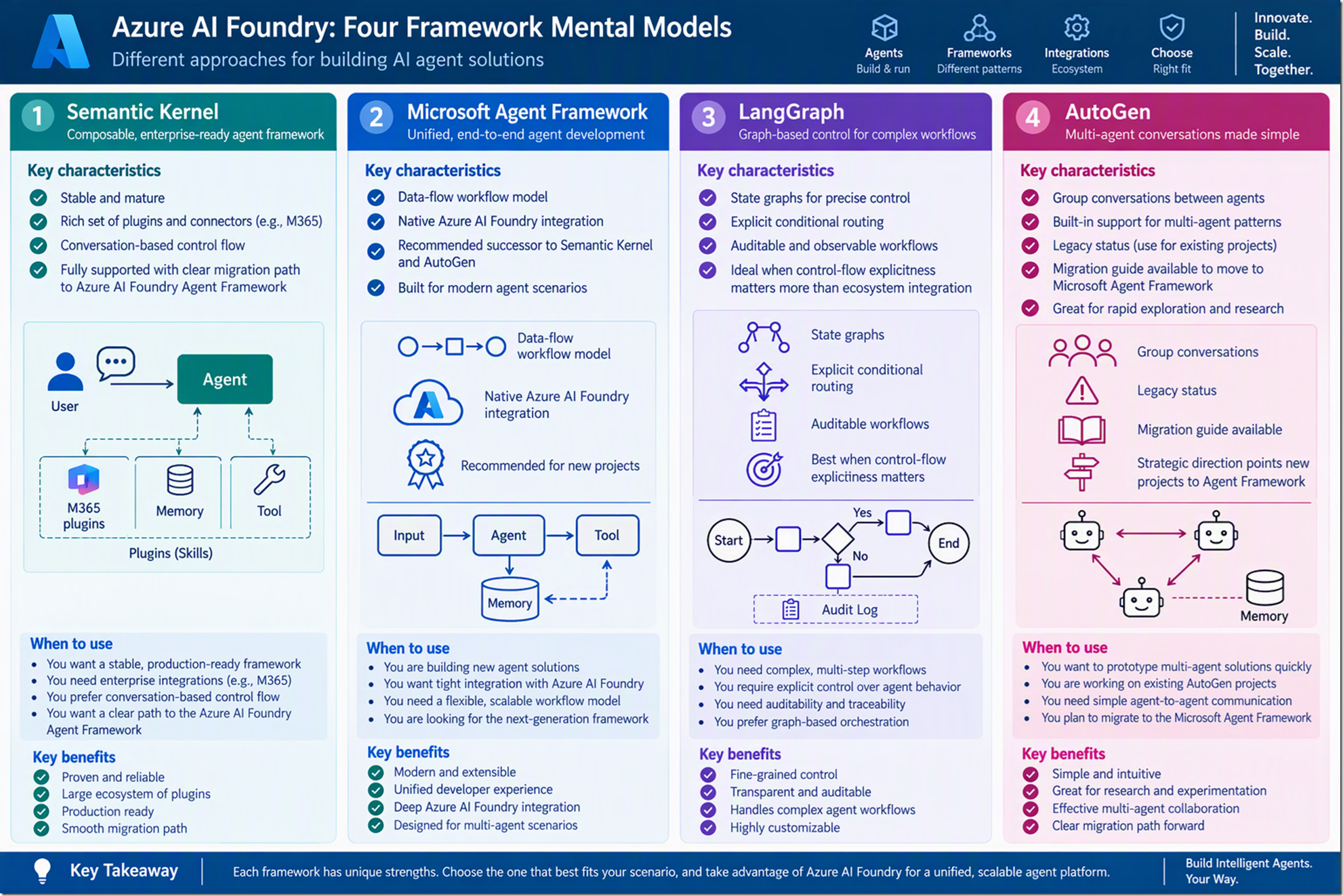
The true level of this text is a summarization of Determine 1 which illustrates 4 framework fashions.
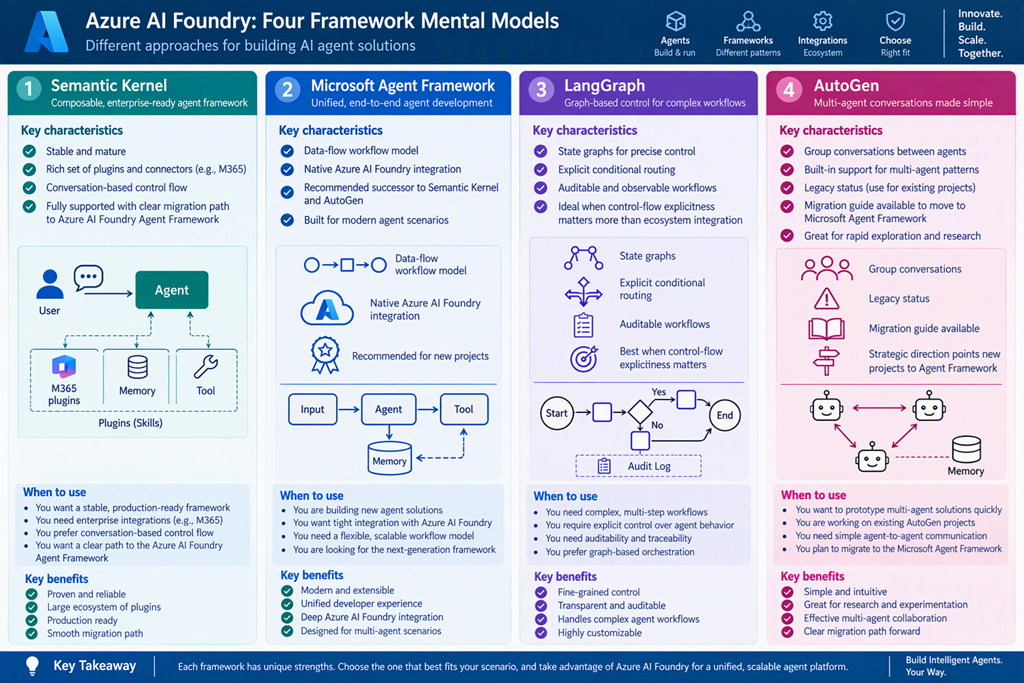
Determine 1, 4 key framework fashions
An important lesson will not be which framework you select. An important lesson is knowing the orchestration patterns that clear up your downside.
Too many discussions about AI brokers start with framework choice. Groups ask whether or not they need to use Semantic Kernel, Microsoft Agent Framework, LangGraph, or AutoGen. In actuality, these choices ought to come after the architectural choices have been made.
Frameworks should not simply collections of APIs and syntax. Each framework embodies a philosophy about how agent methods ought to be composed, coordinated, and executed. In consequence, the framework you select naturally influences the orchestration patterns that turn into simpler to implement.
Desk 1, framework comparability matrix
| Framework | Architectural Philosophy | Greatest-Suited Orchestration Patterns | Enterprise Alignment | Strategic Place |
| Microsoft Agent Framework | Workflow-centric agent methods with specific data-flow orchestration | Workflow orchestration, hub-and-spoke, concurrent execution, multi-agent workflows | Deep Azure AI Foundry integration, managed id, enterprise governance, M365 connectivity | Microsoft’s really helpful framework for brand spanking new agent initiatives and the strategic evolution of its agent ecosystem |
| Semantic Kernel | Functionality-centric orchestration constructed round brokers, plugins, reminiscence, and expertise | Hub-and-spoke, handoffs, collaborative agent interactions, conversational orchestration | Mature Azure and M365 integration with a big plugin ecosystem | Confirmed enterprise framework with a transparent migration path towards Microsoft Agent Framework |
| LangGraph | Graph-oriented workflow execution the place management circulation is explicitly modeled as states and transitions | Supervisor architectures, conditional routing, stateful workflows, advanced choice timber | Azure integration obtainable by means of LangChain parts and customized implementations | Ideally suited when traceability, auditability, and deterministic execution paths are main necessities |
| AutoGen | Agent-to-agent collaboration by means of conversational interactions | Group chat, collaborative reasoning, distributed downside fixing | Azure OpenAI integration however restricted enterprise workflow capabilities | Helpful for current implementations, although new initiatives ought to typically consider Microsoft Agent Framework first |
| CrewAI | Crew-based process delegation with role-driven brokers | Hierarchical groups, delegation chains, manager-worker patterns | Primarily model-focused with fewer enterprise platform integrations | Helpful for speedy experimentation, although enterprise adoption stays much less established |
For instance, Semantic Kernel favors a conversational and capability-centric mannequin. Its wealthy plugin ecosystem, enterprise integrations, and simple agent abstraction make hub-and-spoke architectures really feel pure and intuitive. A central orchestrator can coordinate specialised brokers, instruments, reminiscence, and exterior methods whereas sustaining a transparent management circulation.
Against this, LangGraph is constructed round specific state graphs and conditional routing. It excels when workflow transparency, auditability, and exact management over execution paths are extra vital than ecosystem integration. A graph-oriented framework fashions a workflow as interconnected nodes and edges, the place every node represents a process, agent, or choice level, and every edge defines a potential transition between states. Somewhat than counting on a central orchestrator making implicit choices, the workflow itself turns into an specific graph that may be visualized, inspected, audited, and modified. This method makes supervisor patterns, advanced branching logic, human-in-the-loop checkpoints, and extremely managed multi-step workflows really feel pure as a result of the execution path is represented instantly within the structure. In consequence, LangGraph is especially properly fitted to eventualities the place control-flow explicitness, traceability, and deterministic conduct matter greater than deep ecosystem integration.
Microsoft Agent Framework introduces a contemporary data-flow workflow mannequin and deep Microsoft Foundry integration. Somewhat than focusing solely on conversations or state graphs, it emphasizes end-to-end agent improvement and scalable workflow composition. For organizations beginning new initiatives, it represents Microsoft’s strategic route and is the really helpful successor to each Semantic Kernel and AutoGen for a lot of future agent eventualities.
AutoGen took a unique method by popularizing multi-agent conversations and collaborative reasoning between brokers. Its simplicity made it extraordinarily priceless for experimentation, analysis, and speedy prototyping. Whereas current options proceed to profit from AutoGen, Microsoft’s strategic route now factors towards the Microsoft Agent Framework for brand spanking new enterprise initiatives.
These 4 frameworks characterize 4 distinct philosophies:
- Semantic Kernel: Enterprise integration and composable capabilities.
- Microsoft Agent Framework: Workflow-driven, end-to-end agent options.
- LangGraph: Specific state administration and graph-based orchestration.
- AutoGen: Agent-to-agent collaboration and conversational coordination.
What is especially attention-grabbing is that real-world methods hardly ever have to commit solely to a single framework. Hybrid architectures have gotten more and more frequent. A crew would possibly use Semantic Kernel or Microsoft Agent Framework as the first orchestration layer due to Azure and enterprise integration necessities, whereas delegating a posh choice tree or routing workflow to a LangGraph sub-workflow. The orchestration sample stays the identical despite the fact that a number of frameworks take part within the implementation.
For this reason architectural considering issues greater than framework choice.
The crucial questions are:
- Ought to the system use a hub-and-spoke mannequin or a supervisor mannequin?
- How ought to partial failures be dealt with?
- When ought to execution happen sequentially versus in parallel?
- Do duties require quorum-based choice making?
- How ought to reminiscence, instruments, and state be shared throughout brokers?
- The place ought to observability and auditability be enforced?
None of those are framework questions. They’re structure questions.
As soon as these choices are made, selecting the framework turns into largely a tactical train pushed by ecosystem match, current investments, crew experience, operational necessities, and long-term assist issues.
Be taught the patterns first.
Perceive hub-and-spoke orchestration, supervisor architectures, workflow graphs, parallel execution, quorum insurance policies, hierarchical delegation, and failure restoration methods. When you perceive these ideas, shifting between frameworks turns into comparatively simple since you are translating architectural intent moderately than studying totally new concepts.
The frameworks will evolve. New frameworks will emerge. Current frameworks will converge and take in concepts from each other. Nonetheless, the underlying orchestration patterns will stay remarkably steady.
Structure is strategic.
Frameworks are tactical.
The groups that perceive that distinction will construct agent methods that survive far longer than the applied sciences used to implement them.
Right here is extra data on this subject.

