


“Zapomniałem” is Polish for “I forgot”.
On Arkency’s Slack, our predominant communication channel, it has been used over 1200 occasions.
And I actually consider I work with exceptionally organized and meticulous individuals.
That solely confirms what I wrote in my earlier publish: organizations are surprisingly good at forgetting.
That publish described how we keep an organizational information graph with an LLM and occasion sourcing.
It was concerning the vacation spot.
This one is concerning the highway that led us there.
Wanting again at how we deal with information at Arkency, I recognized 6 ranges of maturity.
I introduced them yesterday at Programistok in Białystok, and I’m scripting this publish on the practice again dwelling.
Examine the place your group stands.
Degree 0: written sources
You talk largely through e mail and instantaneous messengers.
You file transcripts of your conversations.
Agreements made on calls are confirmed in writing: somebody posts a word stating what the events have agreed on.
This was our start line.
Arkency embraced distant work lengthy earlier than it was cool, and the async distant philosophy has all the time relied on written artifacts: standing updates, assembly summaries, resolution information.
Degree 1: one silo
All the above, and moreover, these written artifacts usually are not scattered throughout many instruments.
They land in a single silo.
That is the stage at which you begin transcribing conferences mechanically and utilizing an LLM to generate summaries.
In our case, we use Slack, and we began recording our conferences on Zoom.
Configuring a Zapier automation that generates a abstract of every assembly and posts it to the fitting channel took actually quarter-hour, together with writing the immediate.
The immediate is 30 traces lengthy.
The price of reaching this stage was near zero.
If you already know what you’re in search of, you’ll often discover it.
Generally solely since you bear in mind a particular phrase that was stated.
Degree 2: semantic search
All the above, and moreover, you’ll be able to search your written sources semantically.
In apply, you now not have to do not forget that particular phrase to search out the fitting piece of information.
At this stage, an embedding mannequin turns chunks of your paperwork into vectors: coordinates on a map of meanings.
When a query is available in, essentially the most semantically related chunks are put into the LLM’s context, so it will probably reply questions on knowledge it was by no means skilled on.
This system is named RAG (Retrieval-Augmented Technology).
It’s hardly information anymore – the concept dates again to 2020 and has been extensively adopted since 2023.
For a lot of corporations, stage 2 is completely sufficient.
If you wish to construct chatbots or digital assistants answering particular sorts of questions (buyer help, onboarding primarily based on product documentation, insurance policies and rules), you don’t have to go additional.
There may be one situation although: the questions should be native.
The reply has to sit down in a single chunk, not be smeared throughout the entire dataset.
And the paperwork ought to be unbiased, not describing a community of dependencies, hierarchies or sequences in time.
Degree 3: the LLM organizes information
All the above, and moreover, you utilize an LLM to create syntheses of your paperwork.
Data about your group now lives exterior the unique sources.
Unstructured knowledge turns into semi-structured.
An ideal instance of this stage is the LLM Wiki proposed by Andrej Karpathy in April 2026.
His start line: RAG is in reality a search engine.
It doesn’t assist to arrange information in a sturdy method – the synthesis occurs from scratch with each query.
As a substitute, he suggests letting an LLM keep a wiki of interlinked markdown recordsdata.
Conventional wikis die as a result of the price of sustaining them grows sooner than the worth they bring about, and in some unspecified time in the future no one updates them anymore.
A mannequin doesn’t really feel that price.
It doesn’t get bored rewriting the identical web page for the 20 th time.
You get not solely a semantic index, but additionally a helpful artifact that each people and brokers can browse.
The feedback beneath the gist level out its weak spots, and the following ranges are largely about addressing them.
Degree 4: a information graph
All the above, however this time the LLM turns unstructured knowledge into formally structured knowledge: a graph of entities and typed relations between them.
The time period was popularized by Google in 2012, after they revealed Introducing the Data Graph: issues, not strings.
The search engine stopped merely matching strings and began recognizing entities.
In 2024, Microsoft stirred up the RAG world with GraphRAG.
They used an LLM to extract nodes and edges from chunks of textual content, then detected communities within the graph – teams of nodes extra strongly related with one another than with the remainder.
Every group will get a abstract.
When a query is available in, an LLM generates a partial reply from every group abstract, filters out the unhelpful ones, and combines the remainder right into a closing reply.
This fashion, an LLM can reply world questions, like “what are the primary themes?” or “what developments can we see?”, the place the reply is unfold over an enormous variety of sources.
Plain RAG can not try this.
Two issues are essential at this stage: an ontology that frames the graph and cuts out the noise, and identification decision that retains the identical entity from showing as many nodes.
I coated each intimately within the earlier publish.
Degree 5: a graph you’ll be able to depend on
That is the place your graph stops being a toy.
In spite of everything, we don’t construct a information graph for the sake of getting one, however for the automations it allows.
At stage 5, your brokers work with the graph, traversing it whereas finishing up complicated duties.
To let that occur, you want stable foundations.
From my perspective, these are the must-haves:
- Human within the loop. The LLM solely proposes modifications, and a human will get an opportunity to assessment them earlier than they land within the graph.
- Full provenance. Each reality traces again to its supply, and each resolution of the mannequin traces again to what it learn from the graph.
- Temporal relations. Relations between entities change over time, and two sources saying various things don’t essentially contradict one another. The graph ought to mannequin time frames as attributes of relations.
The place are you?
On the finish of the discuss, I requested the viewers to lift their arms, stage by stage.
Once I requested who makes use of a information graph of their firm, just a few arms went up.
Data graphs as a basis for AI brokers are nonetheless a contemporary subject.
I’m at present studying Agentic GraphRAG by Anthony Alcaraz and Sam Julien (O’Reilly) – its paperback version comes out in simply two days.
It expands on a lot of what I described right here as stage 5.
And if you wish to transfer your group up a stage or two, get in contact.
Final however not least, large because of the organizers of Programistok for an ideal convention and for having us in Białystok.
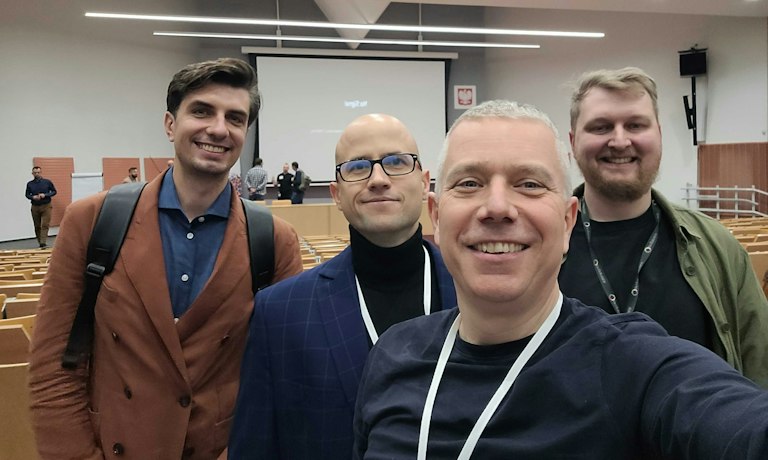
From the left: me, Tomek, Piotrek and Maciej.

