


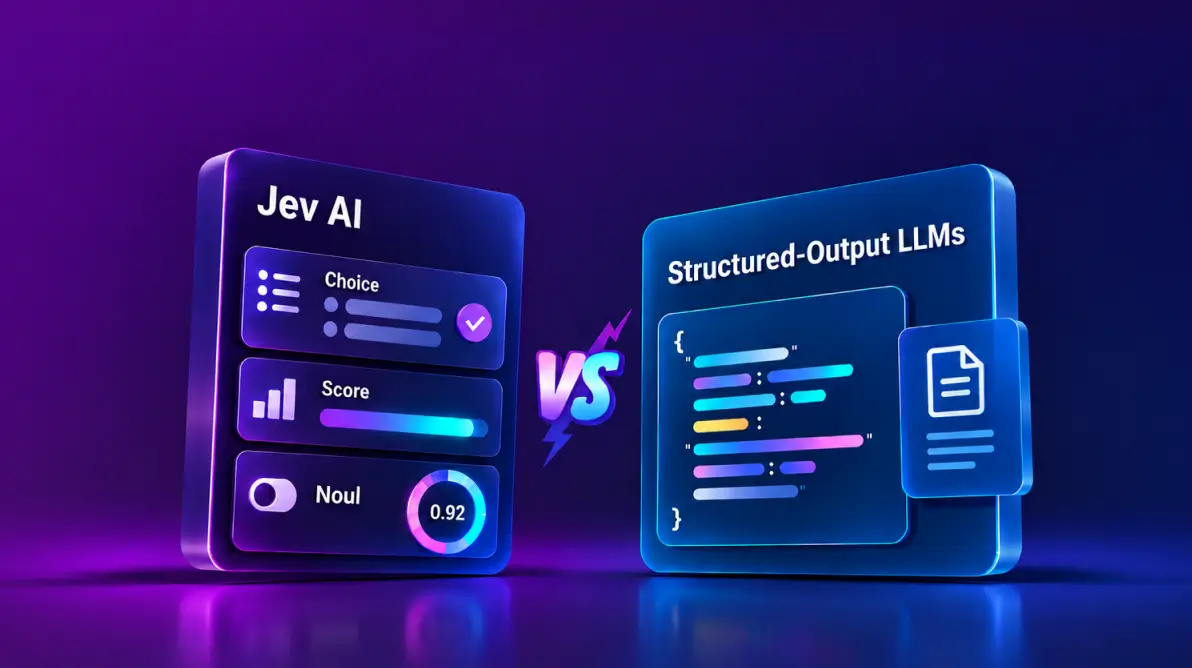
TL;DR: Selecting between Jev AI and structured-output LLMs? It comes all the way down to the duty. Jev AI is nice for fast choices like categorizing, scoring, and routing, whereas structured-output LLMs deal with duties like extracting information, explaining outcomes, and planning. Want each? You’ll be able to mix them. Simply bear in mind: well-formatted output doesn’t all the time imply an accurate resolution. Take a look at with your individual information, and preserve important enterprise guidelines in your utility code.
Think about a buyer submits a assist ticket saying they’re locked out of their account. Your AI mannequin reads the ticket, returns completely formatted JSON, and routes the difficulty to the billing workforce as an alternative of safety.
Right here’s an instance response:
{
  "route": "billing",
  "precedence": "low",
  "requires_human_review": false
}
The format is flawless. The choice is unsuitable.
That’s the issue in a nutshell. A mannequin can return a solution that passes each structural examine and nonetheless misunderstand the precise state of affairs.
There are two approaches price contemplating:
-
Structured-output LLMs: Constrain a mannequin’s response to a format or schema you outline.
-
Typed resolution fashions like Jev AI: Return clear, bounded solutions, reminiscent of a class, rating, or sure/no likelihood.
On this information, we’ll discover how every method works, when to make use of it, find out how to take a look at it, and the place doc information suits into the method.
A notice on sources: Details about Jev AI and its maker, TypeSafe, on this article is predicated on their revealed documentation on the time of writing. Deal with any efficiency, pace, value, or functionality claims because the supplier’s reported figures till you’ve examined them with your individual information. All the time examine the official TypeSafe Fast Begin and API Reference for the most recent request and response codecs earlier than implementation.
How we used to deal with messy mannequin output
For a very long time, working with LLM output concerned the identical repetitive course of: write detailed immediate directions, parse the JSON, validate it, and retry at any time when the response broke the anticipated format.
Then suppliers reminiscent of OpenAI and Anthropic launched structured-output options. These permit builders to constrain a mannequin’s response to a predefined schema. That’s a major enchancment, though the precise guidelines and capabilities fluctuate by supplier and API model.
Structured output helps handle a number of frequent issues:
-
Required fields should be current.
-
Discipline sorts stay constant.
-
Dropdown-style values keep throughout the allowed choices.
-
Instrument inputs match their definitions.
-
Your utility code spends much less time dealing with malformed JSON.
Nonetheless, structured output doesn’t assure that the reply is right. It controls the form of the response, not the accuracy of the mannequin’s judgment.
Structured outputs in 60 seconds
A structured-output LLM is a daily text-generating mannequin configured to return its response in a format you outline.
For instance, you would possibly outline a TypeScript sort for assessing assist tickets:
sort TicketAssessment = "technical" ;
This method is helpful when a process requires greater than a easy resolution, reminiscent of:
-
Extracting a number of fields from a contract.
-
Writing a proof for a human reviewer.
-
Summarizing an incident earlier than categorizing it.
-
Making a step-by-step plan.
-
Changing a dialog into device inputs.
-
Returning supporting quotes or proof alongside a solution.
The largest benefit is flexibility. One mannequin can interpret directions, summarize info, generate textual content, name instruments, and populate structured information.
The limitation is that matching a schema doesn’t show the content material is correct or that the mannequin’s confidence is dependable. For instance, a area reminiscent of “confidence”: 0.93 is only a quantity generated by the mannequin till you’ve examined how typically its predictions are literally right.
So, what’s Jev AI?
Jev AI is TypeSafe’s flagship System One mannequin. The identify displays its focus: fast, bounded judgments slightly than prolonged reasoning or essay writing.
As an alternative of returning paragraphs, Jev AI offers clear, typed solutions.
You ship Jev two issues:
-
State: The knowledge it wants to guage, reminiscent of a assist ticket, transaction, coverage, or utility information.
-
Typed questions: The particular choices you need it to make.
Jev AI returns solutions via three important constructing blocks:
-
Alternative: Selects one possibility from an inventory you outline and offers the likelihood for every possibility, together with a confidence worth.
-
Rating: Evaluates a state of affairs towards ranges you outline and returns a rating, the likelihood for every stage, and a confidence worth.
-
Noul: Solutions a single sure/no query and offers the likelihood that the reply is sure.
There’s additionally an experimental Field constructing block for image-related duties. Nonetheless, TypeSafe identifies it as a function that’s nonetheless altering, so keep away from relying on it for important workflows till its habits is established. All the time verify these definitions within the present documentation.
The hot button is to interrupt a big resolution into smaller, particular questions.
As an alternative of asking a mannequin, “Take a look at this ticket and determine what to do,” you would ask:
-
Alternative: Which workforce ought to deal with this ticket?
-
Rating: How severely is the client affected?
-
Noul: Does this example require fast human evaluation?
Your utility code then makes use of these solutions alongside enterprise guidelines and authoritative account information to make the ultimate resolution.
Jev AI vs. Structured-Output LLMs: A side-by-side comparability
Capabilities fluctuate by supplier, mannequin, and model. Use this comparability as a normal information slightly than a assure about each obtainable device.
| Comparability | Jev AI | Structured-output LLM |
|---|---|---|
| What do you ship? | State and typed questions. | A immediate and a schema or device definition. |
| What do you get again? | Alternative, Rating, and Noul responses. |
Objects, arrays, or device inputs that match your schema. |
| Can it generate prose? | Not likely. That’s not its major objective. | Sure, when the schema permits textual content fields. |
| What confidence info is offered? | Alternative and Rating present chances and confidence. Noul offers a sure likelihood. |
Some fashions present confidence-like values, however you need to take a look at whether or not they’re reliable. |
| How is the output managed? | Constrained to the chosen constructing block. | Some APIs implement the schema. Obtainable options fluctuate. |
| The place ought to enterprise guidelines stay? | In your utility code. | In your utility code, not buried in prompts. |
| What’s it greatest suited to? | Sorting, scoring, routing, and gating. | Extracting, explaining, planning, and producing. |
| What’s the largest limitation? | A legitimate reply can nonetheless be unsuitable. | A legitimate reply can nonetheless be unsuitable. |
Understanding Jev AI’s confidence values
For Alternative and Rating, Jev AI offers a confidence worth between 0 and 1. This worth displays how clearly the possibilities level towards one consequence.
If one possibility clearly stands out, confidence is excessive. If the possibilities are shut, confidence is low.
Noul doesn’t present a separate confidence area. Its output is the likelihood that the sure/no assertion is true.
In both case, take a look at these values towards your individual labeled information earlier than counting on them.
A bounded reply can nonetheless be unsuitable
Suppose a Alternative query permits solely 4 choices: billing, technical, safety, and different.
Jev AI can’t return a fifth possibility exterior that listing. Nonetheless, it might probably nonetheless choose billing for a ticket that describes a safety drawback.
Staying throughout the allowed choices doesn’t imply the chosen possibility is right.
Which one must you select?
Right here’s a easy approach to determine:
-
Want textual content technology, information extraction, or planning? Use a structured-output LLM.
-
Want a transparent, bounded resolution? Attempt Jev AI.
-
Must generate information and make choices about it? Use each collectively.
-
Have a non-negotiable rule? Preserve it in utility code, not in a mannequin.
First, the place does the information come from?
Right here’s one thing that’s simple to miss: each approaches rely on the standard of the information you present.
Feed a mannequin incomplete or incorrect info, and you may get assured, well-formatted however equally incorrect outcomes.
In most enterprise purposes, that info begins in paperwork. These would possibly embrace PDFs, Phrase information, Excel spreadsheets, scanned photos, or e mail attachments.
Changing these information into clear, usable information is a document-processing process. That’s the place the Syncfusion® Doc SDK might help:
A typical document-to-AI pipeline
An actual-world pipeline would possibly appear to be this:
-
Extract doc content material: Use Syncfusion® Doc SDK to retrieve content material from the supply file with out involving an AI mannequin.
-
Construction the information: Use a structured-output LLM to prepare the extracted content material into fields reminiscent of names, dates, and line objects.
-
Make bounded choices: Use Jev AI to reply particular questions concerning the structured information, reminiscent of which queue ought to deal with it, how severe a mismatch is, or whether or not it needs to be escalated.
-
Apply utility guidelines: Use your code to implement non-negotiable guidelines and validate choices towards authoritative information.
The profit is simple: dependable doc processing offers your AI layer cleaner enter. This additionally helps guarantee your assessments measure the mannequin’s efficiency slightly than errors launched throughout doc parsing.
Discover the Syncfusion Doc SDK documentation and samples to search out the codecs and APIs that suit your platform.
A sensible approach to join every part
The golden rule is easy: preserve mannequin judgments separate from exhausting guidelines.
Safety, authentication, permissions, compliance, and validation guidelines ought to run independently. A mannequin mustn’t ever be allowed to override them.
Right here’s the workflow:
-
Begin with a doc supply, reminiscent of a PDF, Phrase doc, Excel spreadsheet, or scanned file.
-
Use the Syncfusion® Doc SDK to extract the content material and convert it into utility information (state).
-
Ship that state via two separate paths:
-
Path 1 – Exhausting guidelines: Apply safety, authentication, and compliance checks to find out the enforced consequence.
-
Path 2 – Mannequin judgments: Use Jev AI or a structured-output LLM, then validate the outcomes towards your checks and danger thresholds.
-
Automate the motion when the result’s sufficiently dependable and low danger.
-
Ship unsure or high-risk outcomes to a human reviewer.
Instance: Imposing a Safety Coverage Earlier than Routing a Ticket
The next instance illustrates how utility code can implement a compulsory safety rule earlier than utilizing model-generated choices.
Necessary: It is a conceptual instance, not production-ready SDK code. It isn’t an actual Jev integration, and TicketDecision just isn’t an actual Jev sort. A manufacturing implementation would additionally have to deal with authentication errors, timeouts, charge limits, and surprising responses. Check with the official TypeSafe documentation for the precise request and response codecs.
sort Division = "billing" | "technical" | "safety" | "different";

sort TicketState = {
  suspectedAccountCompromise: boolean;
};

sort TicketDecision = {
  division?: { selection?: unknown; confidence?: quantity };
  immediateEscalation?: { noul?: quantity };
  affect?: { rating?: quantity; confidence?: quantity };
};

sort NextStep =
  | { motion: "security_review"; motive: "mandatory_security_policy" }
  | { motion: "human_review"; motive: string }
  | { motion: "auto_route"; workforce: Division };

const departments = ["billing", "technical", "security", "other"] as const;

perform isDepartment(worth: unknown): worth is Division {
  return (
    typeof worth === "string" &&
    (departments as readonly string[]).contains(worth)
  );
}

const inUnitInterval = (worth: unknown): worth is quantity =>
  typeof worth === "quantity" && Quantity.isFinite(worth) && worth >= 0 && worth <= 1;

const inImpactRange = (worth: unknown): worth is quantity =>
  typeof worth === "quantity" && Quantity.isFinite(worth) && worth >= 0 && worth <= 3;

perform chooseNextStep(state: TicketState, outcome: TicketDecision): NextStep {

  if (state.suspectedAccountCompromise) {
    return { motion: "security_review", motive: "mandatory_security_policy" };
  }

  const division = outcome.division;
  const immediateEscalationProbability = outcome.immediateEscalation?.noul;
  const affect = outcome.affect;

  const legitimate =
    division !== undefined &&
    isDepartment(division.selection) &&
    inUnitInterval(division.confidence) &&
    inUnitInterval(immediateEscalationProbability) &&
    affect !== undefined &&
    inImpactRange(affect.rating) &&
    inUnitInterval(affect.confidence);

  if (!legitimate) {
    return { motion: "human_review", motive: "invalid_or_missing_model_output" };
  }

  const sensitiveRoute = division.selection === "safety" || affect.rating >= 2.5;
  const unsure = division.confidence < 0.85 || affect.confidence < 0.8;

  if (sensitiveRoute || unsure || immediateEscalationProbability > 0.75) {
    return { motion: "human_review", motive: "risk_or_uncertainty_threshold" };
  }

  return { motion: "auto_route", workforce: division.selection };
}
Understanding the affect scale
The instance makes use of the next affect ranges:
-
0: No one notices.
-
1: Minor situation, with a workaround obtainable.
-
2: One thing vital is damaged for a number of customers.
-
3: A serious outage, safety publicity, or related situation.
The thresholds within the instance, 2.5, 0.85, 0.80, and 0.75, are illustrative values, not really useful defaults.
Select your individual thresholds utilizing actual labeled information. Contemplate the price of an incorrect resolution, your workforce’s evaluation capability, and the way simply an motion may be reversed.
The Noul query on this instance is: “Does this ticket want a human straight away?”
Outline precisely what that query means earlier than permitting its likelihood to affect an utility motion.
The place can you utilize these approaches?
Listed here are three sensible situations the place Jev AI and structured-output LLMs can work collectively.
1. Assist and incident triage
Jev AI is helpful while you repeatedly have to route assist tickets to groups, rating their affect, or determine potential escalations.
A structured-output LLM is a greater match while you additionally have to summarize a ticket, extract replica steps, or draft a response.
Identified account-compromise alerts ought to all the time comply with the necessary safety path. Jev AI might help assess much less apparent instances, nevertheless it ought to by no means override that rule.
2. AI-Agent guardrails
Earlier than an AI agent points a refund, adjustments permissions, or deploys an utility, a typed resolution mannequin can present a danger sign.
Nonetheless, authentication, permission checks, limits, and audit logging stay the duty of your utility.
3. Doc processing
Structured-output LLMs are typically higher suited to extracting names, dates, clauses, and line objects from paperwork. This will occur after a Syncfusion® Doc SDK has already transformed the supply file into clear textual content.
Jev AI can then consider the extracted info and make bounded choices. For instance, it might probably assign a evaluation queue, rating the seriousness of a mismatch, or assess whether or not sufficient proof exists to automate a step.
On this workflow, one mannequin turns content material into structured information, whereas the opposite makes bounded choices about that information.
Each approaches nonetheless want validation towards your precise data.
The right way to take a look at it correctly (don’t skip this)
Earlier than utilizing both method in an actual workflow, that you must perceive how reliably it performs.
First, let’s make clear one vital time period: calibration.
Calibration measures whether or not a mannequin’s confidence matches actuality. For instance, if a mannequin says it’s 90% assured throughout a gaggle of predictions, it needs to be right about 90% of the time for that group to be nicely calibrated.
If the arrogance doesn’t match precise outcomes, you shouldn’t depend on that quantity to make choices.
Begin with a labeled take a look at set
Select one workflow that’s simple to reverse. Earlier than connecting the mannequin to an actual motion, construct a labeled take a look at set.
Embrace:
-
Regular, easy instances.
-
Ambiguous instances.
-
Circumstances with lacking info.
-
Unusually worded or deceptive instances.
-
Uncommon however high-impact situations.
Additionally, preserve the next factors in thoughts:
-
For Alternative: Add an different or needs_review possibility except your listing of decisions is genuinely full.
-
For Rating: Outline every stage utilizing observable standards.
-
For Noul: Ask one query at a time so the response stays clear.
A sensible testing guidelines
As soon as your take a look at set is prepared, comply with these steps:
-
Ask area specialists to outline the right solutions and resolve disagreements.
-
Construct a confusion matrix to determine which classes are being combined up.
-
Measure precision and recall for every class as an alternative of relying solely on general accuracy.
-
Take a look at calibration by grouping predictions and evaluating their confidence with precise outcomes.
-
Set thresholds primarily based on danger, evaluation capability, and the price of errors.
-
Run the brand new method in shadow mode, the place it observes instances with out taking motion.
-
Monitor pace (P50, P95, and P99), value per resolution, escalation frequency, and adjustments within the enter information over time.
A fast instance: Measuring safety recall
Suppose you take a look at 100 confirmed safety incidents.
The system appropriately routes 92 incidents to safety and misses eight. That provides you 92% recall for safety on this take a look at set.
That’s helpful info, nevertheless it doesn’t let you know how typically the system incorrectly routes non-security tickets to the safety workforce.
To measure that, calculate precision utilizing the false positives throughout your full take a look at set. Then validate each precision and recall utilizing recent holdout information earlier than transferring to manufacturing.
Roll out step by step and monitor outcomes
As soon as shadow testing produces acceptable outcomes, roll out the workflow step by step. Outline your rollback circumstances earlier than enabling stay actions.
Contemplate rolling again if:
-
Safety recall drops.
-
Confidence calibration adjustments considerably.
-
Human evaluation quantity will increase unexpectedly.
-
Response occasions turn out to be too gradual.
-
The price of correcting errors turns into too excessive.
Yet another suggestion: pin the mannequin model at any time when potential.
If the supplier makes use of a transferring mannequin label, document the label, date, questions, analysis standards, and take a look at outcomes. Repeat your assessments at any time when the supplier adjustments the mannequin or its habits.
Lastly, deal with any pace or value figures revealed by TypeSafe as provider-reported outcomes till you reproduce them utilizing your individual information, site visitors, and evaluation course of.
Nonetheless undecided? Comply with this resolution move
Use these questions to decide on the precise method:
-
Want generated textual content, information extraction, or variable-length output? Use a structured-output LLM.
-
Can the duty be expressed as a selection, rating, or sure/no query? Attempt a typed resolution mannequin like Jev AI.
-
Does the duty match neither method? Rework it or deal with it in plain utility code.
-
Must generate information and make choices about it? Use each approaches collectively.
-
Is the requirement a non-negotiable rule involving safety, authentication, or compliance? Implement it in utility code, by no means in a mannequin.
Fast glossary
-
System One mannequin: A mannequin designed for quick, bounded choices slightly than deep reasoning.
-
Noul: A Jev AI constructing block that returns the likelihood {that a} sure/no assertion is true.
-
Calibration: A measure of whether or not a mannequin’s confidence matches how typically it’s right.
-
Constrained decoding: A way that constrains a mannequin’s output to an outlined construction.
-
Semantic correctness: Whether or not a solution is definitely right, slightly than merely well-formatted.
Steadily Requested Questions
What can I feed Jev AI?
In accordance with TypeSafe’s documentation, Jev AI accepts textual content within the type of a string, JSON object, or array of textual content values. It doesn’t immediately settle for audio or video.
Convert these inputs into textual content first. A doc SDK might help course of supported information, however you must nonetheless validate the transformed content material earlier than counting on the ensuing resolution.
Can I take advantage of Jev AI for regulated choices?
Jev AI can help with regulated workflows, however a likelihood alone might not fulfill necessities involving explanations, equity, or auditing.
Preserve data of the enter, questions, mannequin model, chances, ultimate consequence, and any human overrides. Get hold of authorized and compliance approval earlier than automating high-impact choices.
What if Jev AI wants info that isn’t within the information I despatched?
A well-structured reply doesn’t show that the enter information is full.
Retrieve authoritative info earlier than making the choice, determine lacking values clearly, and supply an unknown or human-review path wherever lacking info may have an effect on the end result.
If I take advantage of Jev AI, do I nonetheless want structured-output LLMs?
Normally, sure.
Many real-world implementations use a structured-output LLM, along with a doc SDK, to arrange the information. A typed resolution mannequin can then consider that information.
They work higher as complementary instruments than as competing options.
Wrapping up
Consider Jev AI as a specialist for small, clearly outlined choices reminiscent of sorting, scoring, and routing. Structured-output LLMs are generalists that deal with duties reminiscent of extracting info, explaining outcomes, planning, and producing textual content.
Many purposes can profit from utilizing each. Preserve non-negotiable guidelines in your utility code, and use a dependable document-processing layer to supply clear enter information.
Begin with one workflow you can simply reverse. Consider accuracy, precision and recall for every class, calibration, pace, escalation charge, and price utilizing actual information.
Solely after these outcomes meet your necessities must you permit a mannequin to affect a stay motion.
The place to go subsequent
-
Assessment the present Jev AI constructing blocks and supported codecs within the official TypeSafe Fast Begin and API Reference.
-
Discover the Syncfusion Doc SDK documentation to learn to convert PDFs, Phrase paperwork, Excel spreadsheets, and scanned information into usable information to your AI workflows.
-
Attempt an extract-then-decide pipeline utilizing certainly one of your individual paperwork.
-
Begin a free Syncfusion trial and consider the Doc SDKs in your utility.

