


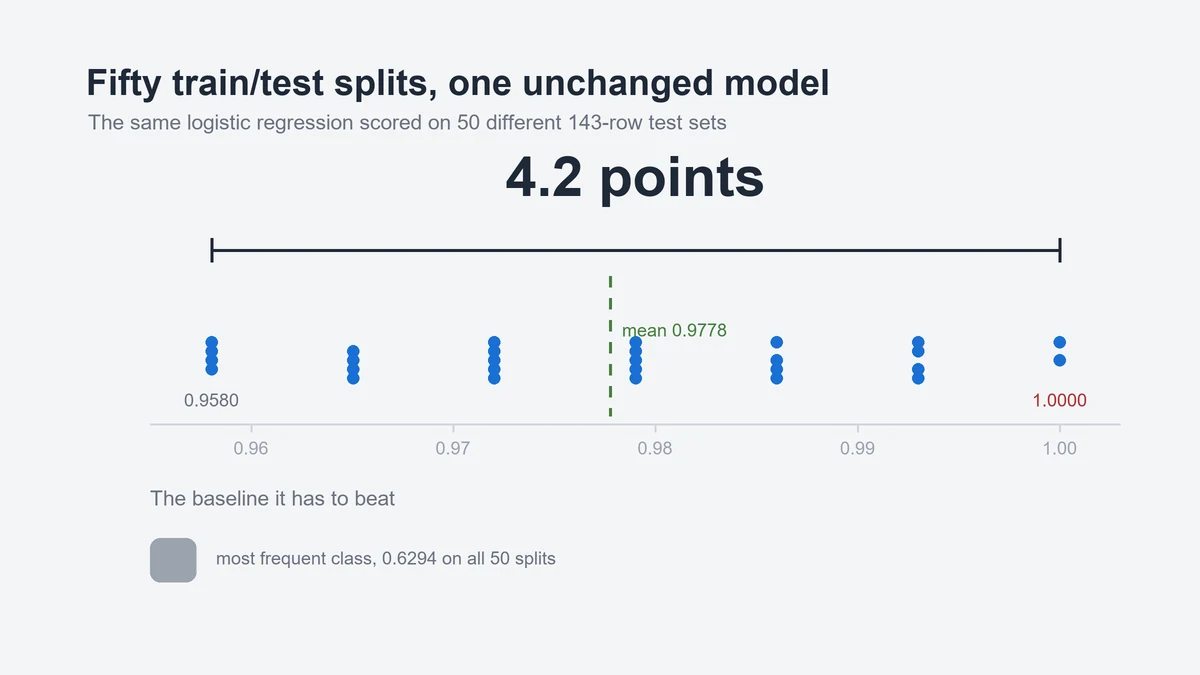
Match the identical logistic regression mannequin to the identical 569 breast most cancers data 50 occasions and alter nothing however which rows land within the check set. The accuracy you’ll report runs from 0.9580 to 1.0000, with a imply of 0.9778. The mannequin, the info, the becoming code and the library model are similar in all 50 runs, and two of them scored an ideal 1.0000 on 143 held-out rows. A reported rating subsequently carries about 4 accuracy factors of motion that the reader by no means sees, and a tutorial that studies one cut up has no strategy to say the place inside that band its quantity fell.
This web page paperwork the protocol behind each machine studying article on MYCPLUS: how knowledge is cut up, what counts as a baseline, how a from-scratch implementation is checked towards a library, what number of repeated splits an enchancment declare wants, what’s recorded concerning the machine the code ran on, and what will get reported when a result’s damaging. Every rule under comes with the measurement that justifies it or the failure it prevents, and the demonstration script is one 193-line Python file that runs in below a minute on one CPU. Each quantity within the tables and figures right here was produced for this web page on Home windows 11 (construct 26300) with Python 3.14.6, NumPy 2.5.5 and scikit-learn 1.9.1, after which reproduced on Ubuntu 24.04.5 below WSL 2 with Python 3.12.3 and the identical library variations: the 50 cut up scores are similar on each programs and the numerical settlement gaps differ within the final two digits, which is proven under. The outcomes quoted from the opposite articles within the collection had been run on Ubuntu 24.04 with Python 3.15.2 and the identical library variations, then repeated on Home windows 11 with Python 3.14.6.
The Quick Reply
- Break up earlier than the rest, and match each transformation on coaching rows solely. A scaler, an imputer or a function selector fitted on the total dataset leaks check info into coaching and inflates the rating.
- Report a baseline in the identical desk because the mannequin. A majority-class classifier scored 0.6294 on the breast most cancers check rows whereas discovering no most cancers in any respect.
- Repeat the cut up and report the unfold, not one rating. Fifty splits of 1 unchanged mannequin spanned 4.20 accuracy factors.
- Evaluate two fashions on the identical splits, not on two totally different splits. The paired commonplace error right here is 0.0016, so variations under about 0.3 accuracy factors aren’t established by this experiment.
- State a tolerance when checking a from-scratch implementation towards a library. Settlement to 1e-14 exhibits the arithmetic matches; it doesn’t present the mannequin is true.
- File variations and seize the output. Each quantity on this web page comes from a file the script wrote, not from a console that was retyped.
Why One Break up Is Not a End result
A check set is a pattern of rows, and the rating computed from it’s a pattern statistic. With 143 check rows, one row is price 0.7 accuracy factors. The 50 splits right here have a regular deviation of 0.0114, which is below two rows. Run the identical mannequin on a distinct 143 rows and it’s regular for the rely of appropriate predictions to maneuver by a row or two both approach, and that is on a dataset the place the mannequin is powerful and the courses are straightforward to separate.
The baseline in that experiment by no means strikes. DummyClassifier(technique="most_frequent") predicts one class for each row, so its accuracy is almost all share of every check set, and stratified splitting retains that share near 62.94 %. Its commonplace deviation throughout the 50 splits is 0.0000 to 4 decimal locations. A baseline with no variance is the appropriate form for the job: it can not enhance as a result of the cut up modified, so it anchors the comparability.
The helpful quantity just isn’t the mannequin’s imply accuracy. It’s the distinction between the mannequin and one thing that makes no selections, measured on similar rows. That distinction averages 0.3484 right here, and since the 2 scores rise and fall along with the issue of the cut up, its commonplace deviation is 0.0114 slightly than the 0.0161 the 2 separate commonplace deviations would counsel. Dividing by the sq. root of fifty offers a regular error of 0.0016, and twice that, 0.0032, is the smallest hole this experiment can name actual. Pairing minimize the noise from 4.2 accuracy factors to 0.3.
The Protocol, in Order
- Break up first, then match the preprocessing. The scaler, imputer, encoder and any function choice go inside a pipeline and see coaching rows solely. Becoming a scaler on all rows earlier than splitting is the commonest leak in introductory tutorials, as a result of it modifications nothing seen within the code and improves the rating by an quantity no person checks.
- Divide 3 ways when a selection needs to be made. Coaching knowledge suits the mannequin, validation knowledge chooses hyperparameters or the choice threshold, and the check set is opened as soon as, on the finish, to report a quantity. Tuning on the check set and reporting the tuned rating is the second commonest leak.
- At all times prepare a baseline that might have been written in three traces. The coaching imply for regression, the bulk class for classification, the prior chances for a probabilistic classifier. The linear regression article’s baseline scored R² −0.012 towards the mannequin’s 0.453, and the logistic regression article’s baseline scored 0.632 accuracy with a recall of zero. The primary would seem like a damaged mannequin and the second like a working one in a abstract that reported a single quantity; each are what a mannequin has to beat.
- Repeat the cut up and report imply, commonplace deviation and vary. Fifty splits on this web page’s demonstration, 100 within the linear regression article, 50 cross-validation suits for the ok within the KNN article. The place randomness impacts the consequence, the variety of repetitions is a part of the consequence.
- Evaluate fashions on the identical splits. The paired distinction and its commonplace error, not two unbiased means and two unbiased commonplace deviations. That is what makes a 0.0032 threshold doable as an alternative of the 0.0046 that two unbiased samples of this measurement would give.
- Test from-scratch code towards a reference with a said tolerance. The rule for this collection is 1e-10 relative on fitted weights and predictions, chosen as a result of it’s far tighter than any modelling distinction and nonetheless unfastened sufficient to not fail on floating-point reassociation. The demonstration script’s least-squares match agrees with scikit-learn to 1.066e-14 relative, which is 4 orders of magnitude contained in the tolerance. State which reference, which cut up and which amount is being in contrast.
- File the atmosphere, not the intention. Python model, each library model, the working system and its construct, and the CPU for something timed. Two machines can disagree about singular matrix behaviour in the identical library, because the linear regression article discovered:
np.linalg.clear upon collinear columns returned weights within the trillions on one machine, raisedLinAlgErroron one other and returned plausible-looking weights on a 3rd. - Seize output to a file and quote the file. A rating pasted from a console into prose drifts from the code the primary time the code modifications. Each output block on this collection comes from a file {that a} script wrote, and the file is dedicated subsequent to the script.
- Run it on a second working system. The demonstration on this web page was run on Home windows 11 and on Ubuntu 24.04.5 below WSL 2 with the identical library variations. Each one of many 50 scores matched to the final printed digit; the 2 numerical settlement gaps moved within the final two digits, and one collinear
clear up()elsewhere within the collection returned weights within the trillions on Linux whereas elevatingLinAlgErroron Home windows with the identical NumPy model. Similar scores are the anticipated consequence; a said tolerance is what makes the comparability significant as an alternative of a hunt for bit equality. - Apply deliberate bugs and make sure every one fails a check. 11 within the linear regression article, 11 in logistic regression, 16 in KNN, 17 in choice bushes. The primary try at this often leaves a survivor: in linear regression, a mutant that eliminated the division by n from the imply squared error handed each check till a check was added that in contrast the reported loss with the definition.
- Benchmark as a measurement, not an illustration. One machine, similar work, warm-up, repeated runs, medians and ranges, and separate names for pure Python, NumPy and C++ at any time when native code is concerned. The KNN article studies 5 implementations and 5 separate ranges slightly than one flattering ratio.
A Labored Run of the Protocol
The script takes one dataset, one mannequin and one baseline and studies what the protocol produces. The dataset ships with scikit-learn, so the script wants no community entry and no obtain step.
| Dataset card | Worth |
|---|---|
| Title | Breast Most cancers Wisconsin (Diagnostic) |
| Entry | sklearn.datasets.load_breast_cancer, bundled because the package deal’s first launch |
| License | Distributed inside scikit-learn, whose licence is BSD-3-Clause |
| Rows and options | 569 rows, 30 numeric options |
| Courses | 212 malignant (37.3%), 357 benign (62.7%) |
| Break up | 75/25, stratified, random_state=0 to 49, 143 check rows per cut up |
| Preprocessing | StandardScaler contained in the pipeline, fitted on coaching rows solely |
| Mannequin | LogisticRegression, max_iter=5000, solver="lbfgs", default C=1 |
| Baseline | DummyClassifier, technique="most_frequent" |
The entire experiment is a loop over cut up seeds. Nothing outdoors the loop modifications, and the scaler lives contained in the pipeline so it can not see the check rows:
def make_model() -> object:
    # Scaling lives contained in the pipeline, so it's fitted on coaching rows solely.
    return make_pipeline(
        StandardScaler(),
        LogisticRegression(max_iter=5000, solver="lbfgs"),
    )


def split_scores(X: np.ndarray, y: np.ndarray) -> dict[str, list[float]]:
    model_scores: listing[float] = []
    baseline_scores: listing[float] = []
    for seed in vary(SPLITS):
        X_train, X_test, y_train, y_test = train_test_split(
            X, y, test_size=TEST_SIZE, random_state=seed, stratify=y
        )
        mannequin = make_model().match(X_train, y_train)
        baseline = DummyClassifier(technique="most_frequent").match(X_train, y_train)
        model_scores.append(float(mannequin.rating(X_test, y_test)))
        baseline_scores.append(float(baseline.rating(X_test, y_test)))
    return {"mannequin": model_scores, "baseline": baseline_scores}
The settlement examine is separate as a result of it asks a distinct query. It suits least squares two methods on one cut up, as soon as by fixing the conventional equations within the least-squares sense with an intercept column appended by hand, and as soon as with scikit-learn, then compares the fitted values:
def tolerance_check(X: np.ndarray, y: np.ndarray, seed: int = 0) -> dict[str, float]:
    """From-scratch least squares towards scikit-learn on the identical cut up."""

    X_train, _, y_train, _ = train_test_split(
        X, y, test_size=TEST_SIZE, random_state=seed, stratify=y
    )
    scaler = StandardScaler().match(X_train)
    X_train_scaled = scaler.rework(X_train)

    # From scratch: add an intercept column and clear up within the least-squares sense.
    design = np.column_stack([X_train_scaled, np.ones(len(X_train_scaled))])
    weights, *_ = np.linalg.lstsq(design, y_train.astype(float), rcond=None)
    scratch = design @ weights

    library = LinearRegression().match(X_train_scaled, y_train.astype(float))
    reference = library.predict(X_train_scaled)

    prediction_scale = max(float(np.abs(reference).max()), 1e-12)
    prediction_gap = float(np.abs(scratch - reference).max())
    weight_gap = float(np.abs(weights[:-1] - library.coef_).max())
    weight_scale = max(float(np.abs(library.coef_).max()), 1e-12)
    return {
        "prediction_gap": prediction_gap,
        "prediction_relative": prediction_gap / prediction_scale,
        "weight_gap": weight_gap,
        "weight_relative": weight_gap / weight_scale,
    }
Operating each offers the web page’s measurements:
MYCPLUS testing protocol: cut up variance and baseline, measured
dataset        breast_cancer: 569 rows, 30 options
class steadiness  0: 212 (37.3%), 1: 357 (62.7%)
protocol       50 stratified splits, test_size=0.25, random_state=0..49
mannequin          StandardScaler then LogisticRegression (default C=1)
baseline       DummyClassifier, most frequent class

mannequin accuracy      imply 0.9778  sd 0.0114  min 0.9580  max 1.0000
baseline accuracy   imply 0.6294  sd 0.0000  min 0.6294  max 0.6294
unfold of 1 mannequin's rating throughout splits   4.20 accuracy factors
splits the place the mannequin scored 1.0000        2 of fifty

paired distinction mannequin - baseline   imply 0.3484  sd 0.0114
commonplace error of that distinction    0.0016
smallest distinction price reporting  0.0032 (two commonplace errors)
splits the place the mannequin beats the baseline   50 of fifty

rating if solely cut up 0 had been run       0.9580
highest-scoring cut up: 37  1.0000  (+2.22 factors from the imply)
lowest-scoring cut up:  0   0.9580  (-1.97 factors from the imply)
hole between the best and lowest cut up     4.20 factors

settlement between the from-scratch match and scikit-learn, cut up 0
max prediction hole        4.330e-15  (relative 3.194e-15)
max coefficient hole       1.066e-14  (relative 1.062e-14)
tolerance used on this collection   1e-10 relative for fitted weights
verdict                         inside tolerance

wrote split_scores.json
Three issues in that output are price separating. The mannequin’s imply is 0.9778, however the person splits run from 0.9580 to 1.0000, and the hole between the very best and worst cut up is 4.20 factors on code that didn’t change. Break up 0 occurs to be the worst of the 50 and cut up 37 the very best, so a primary try and a fortunate rerun can differ by 4.2 factors on similar code. The baseline sits at 0.6294 on each cut up, and the paired distinction towards it has a regular error of 0.0016, which is what makes a 0.3-point declare defensible and a 0.1-point declare not.
The settlement output reads 4.330e-15 for predictions and 1.066e-14 for coefficients on Home windows, and a couple of.554e-15 and 4.774e-15 on Ubuntu, on the identical cut up with the identical library variations. Each are on the degree the place double-precision arithmetic stops discriminating, which is the anticipated consequence for 2 implementations of the identical least-squares downside. The hole between the 2 programs just isn’t a bug in both: including the identical merchandise in a distinct order strikes the final digit or two, and the linear algebra libraries are constructed in a different way on the 2 platforms. A line-by-line diff of the 2 captures has precisely two differing traces, the 2 settlement gaps, and nothing else. That’s the reason the collection states a tolerance of 1e-10 as an alternative of claiming bit-identical output. The examine is proof that the from-scratch code computes what scikit-learn computes. It isn’t proof that the match is an efficient mannequin of something, and the web page doesn’t declare that.
| Settlement examine, cut up 0 | Home windows 11, Python 3.14.6 | Ubuntu 24.04.5, Python 3.12.3 |
|---|---|---|
| Most prediction hole | 4.330e-15 | 2.554e-15 |
| Relative prediction hole | 3.194e-15 | 1.883e-15 |
| Most coefficient hole | 1.066e-14 | 4.774e-15 |
| Relative coefficient hole | 1.062e-14 | 4.759e-15 |
| Towards the 1e-10 tolerance | Inside, by about 4 orders | Inside, by about 4 orders |
| The 50 cut up scores | Imply 0.9778, sd 0.0114, vary 0.9580 to 1.0000 | Similar to the final printed digit |
The Identical Protocol, Already Utilized
4 articles within the collection have been by means of it. The counts are from their very own claims audits, and every article’s “What I Verified” desk is the report.
| Article | Information | Break up | Unit checks | Deliberate bugs caught |
|---|---|---|---|---|
| Linear regression | 442 diabetes data, 10 options | 353/89 | 22 | 11 of 11 |
| Logistic regression | 569 breast most cancers data, 30 options | 455/114 | 20 | 11 of 11 |
| Ok-nearest neighbors | 178 wine data, 13 options | 133/45 | 20 | 16 of 16 |
| Choice bushes | 569 breast most cancers data, 30 options | 455/114 | 19 | 17 of 17 |
Three findings from these runs present why the protocol just isn’t paperwork. The linear regression article ran 100 splits and located check R² anyplace from 0.258 to 0.658 round a imply of 0.467, so a single cut up in that vary can understate or overstate the mannequin by 0.2 of R². The choice tree article grew 20 bushes with nothing modified however random_state and obtained bushes that categorised between 103 and 109 of the identical 114 tumours accurately. And the collinear-matrix discovering above got here from a deliberate bug hunt, not from studying documentation.
What the Protocol Can not Do
It can not make a weak mannequin good, and it can not inform you whether or not the duty issues. An ideal rating on a dataset with a leaking function continues to be a damaged consequence, and no variety of splits detects it.
It additionally assumes one thing concerning the rows. Repeated random splits deal with observations as exchangeable, which is flawed for time collection, the place the cut up has to respect chronology, and for grouped knowledge corresponding to a number of photos of 1 affected person, the place a group-aware cut up is required to maintain the check set unbiased. Neither case seems within the pilot articles, and each would wish the protocol prolonged earlier than it utilized.
Lastly, settlement and mutation checks aren’t correctness. Two implementations of the identical flawed system conform to 1e-14. A check suite that catches each mutant you considered says nothing concerning the bug you didn’t consider. These checks increase the ground; they don’t certify the ceiling.
Widespread Methods a End result Misleads
Scoring on the rows the mannequin was fitted on. A mannequin at all times seems higher on its coaching knowledge, and the hole between coaching and check scores is itself diagnostic. Report each, and deal with a small hole with suspicion when the mannequin is versatile.
Becoming the scaler on all the things. The leak is invisible within the code and prices a fraction of some extent, which is strictly why it survives overview. Put the scaler in a pipeline.
Reporting a distinction smaller than the paired noise. The quantity to check towards is the usual error of the paired distinction, not a rule of thumb about proportion factors. Right here that threshold is 0.0032.
Selecting the metric after seeing the outcomes. Accuracy on a 62.7/37.3 cut up scored 0.6294 with a recall of zero. A metric chosen earlier than the run, and reported with the confusion matrix, is more durable to suit to a narrative after the actual fact.
Quoting a benchmark with out its vary. The KNN article’s C++ implementation measured between 268.7 and 291.5 microseconds per question throughout 5 runs on one machine. A type of numbers alone is a declare a couple of machine’s temper, not about an implementation.
Key Takeaways
- A single prepare/check cut up is one pattern. A 4.20-point vary on similar code is regular, so the cut up is a part of the consequence and belongs within the report.
- A baseline just isn’t optionally available. It’s the solely quantity that claims whether or not a mannequin realized something, and it’s often three traces of code.
- Pair the comparability. Two fashions in contrast on the identical splits give a 0.3-point threshold; on totally different splits, the 4.2-point vary between splits is the noise they’re arguing over.
- State a tolerance for from-scratch towards library. Settlement to 1e-10 relative or higher is the collection’ rule, and the path of the examine issues: it validates arithmetic, not modelling.
- Repeat and disclose. Fifty splits, 100 splits, 50 cross-validation suits; the rely is a property of the declare.
- Seize the output, report the atmosphere, run it twice on two programs. The second system right here matched each rating and moved the settlement gaps within the final two digits, which is what a said tolerance is for; the one real platform disagreement on this collection to this point confirmed up solely on the second system.
Conclusion
The protocol just isn’t sophisticated: cut up first, match preprocessing contained in the cut up, hold a baseline, repeat, pair, state a tolerance, report variations, seize output, break the code on objective, and run it some place else. What makes it work is that every step produces a quantity that may be checked, and the numbers listed here are sufficiently small to suit on one web page.
Each article on this collection carries a “What I Verified” desk on the finish for precisely this motive, and the pages that use this protocol are collected within the synthetic intelligence part. For a similar protocol utilized to a scored classifier with an unbalanced check set, see logistic regression, the place the majority-class baseline scores 0.632 accuracy and finds no malignant tumour in any respect.
Supply Code and Assessments
The demonstration is one file, protocol_check.py, and it’s within the machine-learning/testing-protocol listing of the MYCPLUS Python examples repository, along with the Home windows and Ubuntu captures this web page quotes. It has no check suite of its personal as a result of it asserts nothing, it studies; the numbers it prints are the numbers this web page quotes, and rerunning it reproduces them precisely on the identical library variations.
Run it:
python -m pip set up -r necessities.txt
python protocol_check.py
It writes outcomes/split_scores.json subsequent to itself and prints the captured output block above. The determine is drawn from that JSON file, so no quantity within the determine is typed by hand.
The 4 algorithm articles cited within the desk have their very own directories, checks and CI workflows within the MYCPLUS Python examples repository: linear-regression, logistic-regression, k-nearest-neighbors and decision-tree.
What I Verified
| Test | Home windows 11 | Ubuntu 24.04.5 (WSL 2) |
|---|---|---|
| Atmosphere | Construct 26300, Python 3.14.6, NumPy 2.5.5, scikit-learn 1.9.1, SciPy 1.18.1 | WSL 2 kernel 5.15.146.1, Python 3.12.3, NumPy 2.5.5, scikit-learn 1.9.1, SciPy 1.18.1 |
| Processor | Intel Core i7-8700K, 3.70 GHz | Identical processor, 12 vCPU seen |
| Demonstration script | Ran to completion; output in outcomes/protocol_check.txt; rerun produced similar numbers |
Ran to completion in a digital atmosphere; output in outcomes/protocol_check-ubuntu.txt |
| 50 splits, mannequin and baseline | Imply 0.9778, sd 0.0114, vary 4.20 factors; baseline 0.6294 on each cut up | Similar to the final printed digit, all 50 scores |
| Paired distinction | Imply 0.3484, commonplace error 0.0016, two commonplace errors 0.0032, mannequin above baseline on 50 of fifty splits | Similar |
| Settlement with scikit-learn | 4.330e-15 on predictions, 1.066e-14 on coefficients | 2.554e-15 on predictions, 4.774e-15 on coefficients |
| Towards the 1e-10 relative tolerance | Inside | Inside |
| Determine | Drawn from outcomes/split_scores.json, values match each captures |
Identical |
| Quoted article outcomes | Taken from the 4 reside articles’ personal claims audits | Not re-run right here |
Not lined: macOS, ARM processors, different Python or library variations, GPU or multi-threaded BLAS settings, and the script has been run on the 2 programs above solely. The protocol guidelines that the 4 algorithm articles exercised on Ubuntu 24.04 with Python 3.15.2 are recorded in these articles, not re-run for this web page.

